

Select your language

- Details
- Category: Museo
-
Also available:

OIL LAMP FOR SIGNALS (1)
 English Version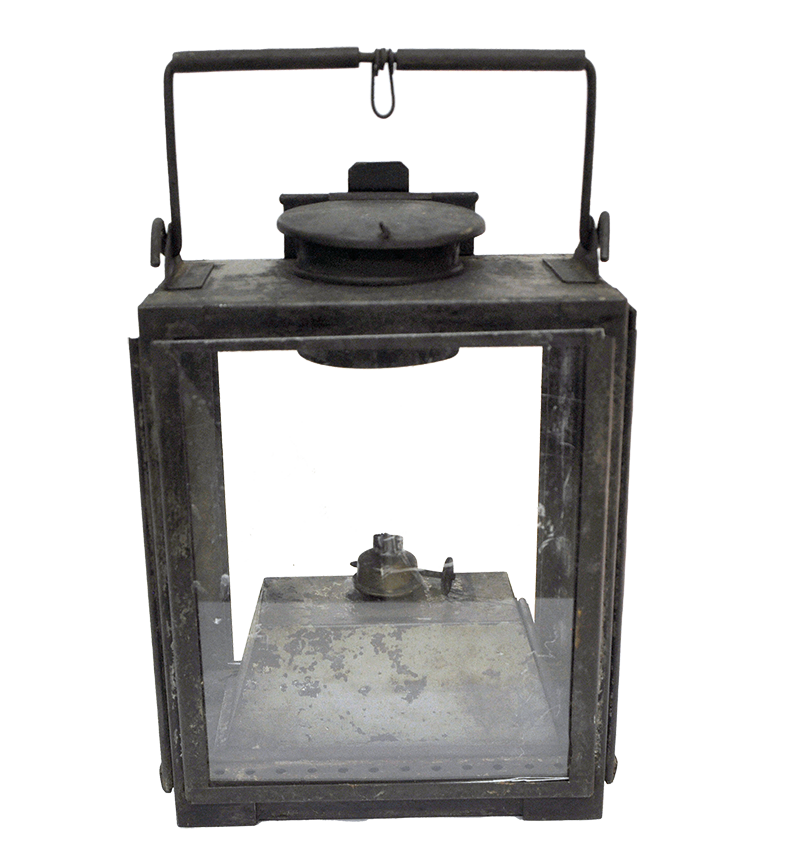
Petrol lantern for protection signals - warning of protection signals and for slowdown signals.
Circular no. 152/7.1 (L.SA. 15/122891 of 1-7-1968) and Appendix no. 1 (L.SA. 22/102338 of 22-3-1971) to the TECHNICAL INSTRUCTIONS art. 1, paragraph 2, point 2.1.1 states:
[…] slow-down signals, intended for outdoor use, consist of: C … in old kerosene lantern signals […]
“[…] to prevent the flame from producing soot, it must initially be kept low until the casing that protects it is suitably heated. The lamp must be adjusted or raised only when the flame burns with uniform intensity so that it cannot become higher and then produce soot. Care must be taken to ensure that the lamps of fixed signals are raised to their correct height; after the lamps have been turned on, the line agent must ensure that the light of the signal see clearly […]”.
LAMP PETROLEUM (KEROSENE)
In the 10th century, the Persian sage Muhammad Al-Razi described the distillation of petroleum to produce illuminating oil in his Book of Secrets.
Kerosene was first refined from coal by Canadian physician and geologist Abraham Pineo Gesner, who gave the first public demonstration of the new production process in 1846 in Charlottetown, Prince Edward Island. Gesner patented his production system, calling it kerosene, in 1854. In 1856, Polish chemist Ignacy Łukasiewicz discovered a way to refine kerosene distilled from less expensive petroleum.
Kerosene was an inexpensive liquid, replacing whale oil in oil lamps; for this reason, it was also called "lamp petroleum." It was "the first source of effective, abundant, and inexpensive light ever made available to mankind." This use of kerosene was abandoned with the advent of electric light bulbs.
Kerosene is obtained by the fractional distillation of petroleum at 150°C to 280°C (carbon chains of 12 to 15 atoms). The aromatic content can reach 25%. In addition to benzene alkylates, significant amounts of indene, naphthalene, and their derivatives are present. Its density ranges from 780 to 810 kg/m³. The flash point is between 37°C and 65°C, and the autoignition temperature is 220°C. The calorific value of kerosene is similar to that of diesel fuel. The lower calorific value is 43.1 MJ/kg and the higher calorific value is 46.2 MJ/kg. Kerosene is practically insoluble in water, and the soluble fraction consists primarily of aromatics.
Pubblicazioni correlate:
Istruzioni per il servizio del personale di linea – edizione 1930 (Biblioteca Ferrovie Arrugginite)
https://it.wikipedia.org/wiki/Cherosene